

A regular checkup isn't an appointment for when something is wrong: it's the one that keeps things from going wrong. Most problems in the mouth start silently. They don't hurt, they don't bother you, and you can't see them in the mirror. By the time they make themselves known, they've progressed. Checkups exist to get there first.
What doesn't hurt still progresses
A small cavity between two teeth causes no symptoms. Early gum inflammation, at most, causes a little bleeding when brushing that many people ignore. Neither stops you from eating, sleeping or working.
But both progress. The cavity reaches the nerve; gingivitis turns into periodontitis and starts affecting the bone that holds your teeth. That's when pain or loose teeth appear, right when the problem has stopped being simple.
The sooner, the simpler
The same problem can be solved in very different ways depending on when it's found:
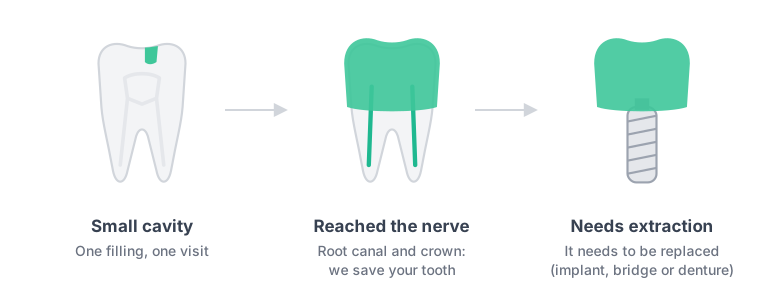
- Cavity found at a checkup: solved with a filling, in a single visit.
- If it reaches the nerve: a root canal lets you keep your own tooth. It's a very predictable treatment and well worth it, but it takes more visits and usually needs a crown.
- If it needs extraction: it's no longer about keeping the tooth but replacing it with an implant, a bridge or a denture.
The same goes for gums: gingivitis can be reversed with cleaning and good hygiene; advanced periodontitis needs more complex treatment, and lost bone doesn't grow back on its own.
And if something already bothers you today, don't wait for your next checkup: every stage has a solution, and the sooner you come in, the more options there are. Regular checkups simply let you arrive at the simplest stage.
Your mouth isn't separate from your body
Inflamed gums aren't just a local problem. The evidence shows that periodontitis and diabetes have a two-way relationship: diabetes makes gum disease worse, and diseased gums make blood sugar harder to control (Preshaw et al., 2012). On the flip side, treating the gums helped improve that control.
A regular checkup is a concrete way to look after your overall health, not just your smile.
What happens at a checkup
Nothing mysterious or uncomfortable:
- Full exam: teeth, gums, tongue and soft tissues, plus any fillings, crowns or implants you already have.
- X-rays, if needed: to see what isn't visible to the naked eye, like cavities between teeth or bone loss.
- Professional cleaning: removes tartar, hardened plaque that brushing and flossing can no longer remove.
- A clear explanation: we show you what we found, with images, and if there's something to treat we talk it through before deciding. Understand first, then decide.
How often
The general reference is every six months, but it's not a fixed rule. Scientific reviews on the topic agree that the ideal interval depends on each person's risk (Riley et al., Cochrane, 2013). Someone with healthy gums and a good routine can space them out; someone with diabetes, a history of periodontitis, implants, braces, or who smokes usually needs more frequent checkups.
That's why we don't give you a generic date: we set yours.
If it's been a while
It happens a lot, and there's nothing to feel bad about. What matters is getting back on track. If it's been more than a year since your last checkup, or if your gums bleed, you have sensitivity or something has changed, now is a good time. Your first consultation is free and we put everything on the table.